
The Blood Relic of Partition: The True Story of Direct Action Day (August 16, 1946)
History often remembers the birth of modern India and Pakistan in August 1947 as a moment of triumphant independence, albeit one scarred by the tragedy of Partition. But the true point of no return—the exact moment when the dream of a united subcontinent was violently shattered—happened exactly one year earlier.
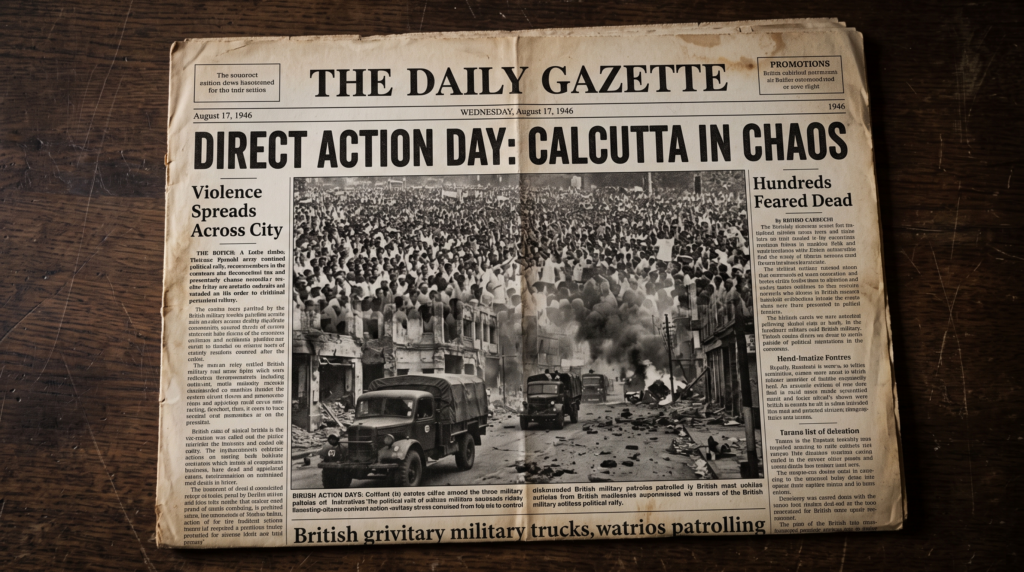
On August 16, 1946, the city of Calcutta (now Kolkata) plunged into an abyss of communal slaughter unparalleled in British Indian history. Known officially as “Direct Action Day” and historically remembered as the Great Calcutta Killings, these 72 hours of unchecked violence fundamentally altered the destiny of South Asia.
For the readers of The Story India, this is the comprehensive, unflinching account of the day the streets of Calcutta ran red, the political maneuvering that ignited the fire, and how a single call to action made the bloody partition of India inevitable.
The Prelude to Chaos: The Failure of the Cabinet Mission
To understand why Direct Action Day happened, one must rewind to the sweaty, tense summer of 1946. World War II had bled the British Empire dry, and London was finally eager to pack up and leave India. However, they faced a massive political deadlock regarding to whom they should hand over the reins of power.
On one side stood the Indian National Congress, led by figures like Jawaharlal Nehru, Sardar Vallabhbhai Patel, and Maulana Azad, who envisioned a united, secular, and democratic India. On the other side was the All-India Muslim League, led by Muhammad Ali Jinnah, who adamantly demanded a separate nation for Muslims—Pakistan—arguing that Muslims and Hindus were two distinct nations who could not survive under a single government.
In a last-ditch effort to keep India united, the British government sent the Cabinet Mission to negotiate a power-sharing arrangement. The Mission proposed a complex, decentralized, three-tiered federal structure for a united India, grouping provinces by religious majority. Initially, both the Congress and the Muslim League cautiously accepted the plan.
However, mistrust ran deep. In July 1946, Jawaharlal Nehru gave a fateful press conference in Bombay where he stated that the Congress would enter the Constituent Assembly “completely unfettered by agreements” and hinted that the proposed groupings could be modified.
Jinnah seized upon this statement. Accusing the Congress of bad faith and the British of appeasement, Jinnah completely withdrew the Muslim League’s acceptance of the Cabinet Mission Plan. The constitutional route had failed. It was time, Jinnah decided, to take the fight to the streets.
The Clarion Call: “We Shall Have India Divided or We Shall Have India Destroyed”
“We have forged a pistol and are in a position to use it. We are bidding goodbye to constitutional methods.”
— Muhammad Ali Jinnah, July 1946
In late July, the Muslim League Council passed a resolution declaring August 16, 1946, as “Direct Action Day.” The purpose was to show the British and the Congress the absolute resolve of the Muslim masses to achieve Pakistan.
The directive was supposed to be a day of peaceful protest, a nationwide general strike (hartal), and public meetings to explain the League’s demand for a separate nation. However, in the highly polarized, communally charged atmosphere of the 1940s, the rhetoric used by local leaders was deeply incendiary. Pamphlets distributed in the weeks leading up to August 16 invoked religious warfare and asked followers to prepare for a final showdown.
The epicenter of this brewing storm was Bengal, the only province in British India governed by a Muslim League ministry, headed by Chief Minister Huseyn Shaheed Suhrawardy.
In a highly controversial move that would have disastrous consequences, Suhrawardy declared August 16 a public holiday in Bengal. While he argued this would prevent clashes between those who wanted to work and those observing the strike, critics—and history—viewed it as a calculated move that freed government officials, police, and workers to participate in the political rallies without constraint.
August 16, 1946: The Eruption of the Great Calcutta Killings
The morning of August 16 broke with an eerie tension over Calcutta. Markets were shuttered, transport was halted, and massive crowds began congregating from all corners of the city, marching toward the Ochterlony Monument (now Shahid Minar) at the Maidan for the grand Muslim League rally.
By early afternoon, the Maidan was a sea of humanity. Estimates suggest that nearly 100,000 people gathered. Chief Minister Suhrawardy addressed the massive crowd. Accounts of his speech vary; while no official transcript exists, intelligence reports and surviving witnesses claimed that Suhrawardy assured the crowd that he had “seen to it that the police and the military would not interfere.”
Whether he intended to incite violence or simply boast of his political control, the crowd interpreted his words as a license to riot. As the rally dispersed, the spark ignited.
The Anatomy of the Violence
What followed was not a riot, but a meticulously organized urban massacre. Calcutta, a city renowned for its intellectual prowess and cultural heritage, descended into primal savagery.
- The Initial Assault: As crowds returned from the Maidan, they began attacking Hindu-owned shops, forcing them to close, and assaulting bystanders. Armed mobs carrying iron rods, lathis, and machetes roamed the streets.
- The Retaliation: The violence did not remain one-sided for long. By the evening of August 16 and into the morning of August 17, Hindu and Sikh communities organized heavy counter-attacks. Local akharas (gymnasiums) mobilized their members. The city was carved into communal fortresses. To cross into the wrong neighborhood meant certain death.
- The Breakdown of Law and Order: The most shocking aspect of Direct Action Day was the complete paralysis of the state. The Calcutta Police, largely inadequate and severely compromised by political pressure, stood by helplessly. For 48 hours, Chief Minister Suhrawardy famously sat in the police control room in Lalbazar, directing operations in a manner that critics claimed deliberately protected rioters of his own community.
- British Inaction: The British Governor of Bengal, Sir Frederick Burrows, initially severely underestimated the situation. Despite the city burning, the British military was not called out in full force until August 18. By the time the army deployed, the damage was irreversible.
A City of Corpses: The Toll of the 72 Hours
“The streets were littered with corpses, and the gutters ran red with blood. Vultures perched on the rooftops, and dogs fought over human remains.”
— Account of a British Journalist in Calcutta, August 1946
When the British military finally regained control on August 19, the sights that greeted them were apocalyptic.
The official death toll remains a matter of historical debate, but conservative estimates place the number of dead at 4,000 to 5,000, with over 100,000 residents rendered homeless. Thousands more were severely injured.
The Hooghly River was choked with floating corpses. The city’s sanitation system collapsed, and bodies rotted in the humid monsoon heat for days before military trucks could bulldoze them into mass graves or burn them on massive, indiscriminate pyres. Neighborhoods like Burrabazar, College Street, and Park Circus were transformed into smoking ruins. Women were abducted, children were orphaned, and the psychological soul of Calcutta was shattered forever.
The Domino Effect: Noakhali, Bihar, and the Punjab Fire
If Jinnah’s goal was to prove that Hindus and Muslims could no longer live together peacefully, the Great Calcutta Killings accomplished it with terrifying efficiency. But Calcutta was merely the first domino to fall. The bloodshed of Direct Action Day triggered a chain reaction of revenge killings across the Indian subcontinent that would last for over a year.
- The Noakhali Riots (October 1946): News of the Hindu retaliations in Calcutta reached the remote, Muslim-majority district of Noakhali in eastern Bengal. In October, massive anti-Hindu pogroms erupted. Villages were burned, forced conversions took place, and thousands of Hindus fled. It was here that a 77-year-old Mahatma Gandhi walked barefoot from village to village in a desperate, lonely bid to restore communal harmony.
- The Bihar Massacres (November 1946): Refugees fleeing Noakhali reached the Hindu-majority province of Bihar, bringing with them horrific tales of violence. This sparked a massive, retaliatory slaughter of Muslims in Bihar, resulting in the deaths of over 7,000 Muslims.
- The Punjab Inferno (1947): The cycle of violence eventually moved westward to the Punjab. By the time the British officially announced the partition plan in 1947, Punjab was already a war zone, leading to the greatest mass migration in human history and the deaths of over a million people.
Why Direct Action Day Changed Indian History Forever
Direct Action Day is not just a tragic footnote in Indian history; it is the definitive turning point that made the Partition of India an absolute certainty.
Prior to August 16, 1946, many leaders within the Indian National Congress still believed that a united India could be salvaged. They believed the Muslim League’s demand for Pakistan was merely a bargaining chip to secure maximum provincial autonomy.
The Great Calcutta Killings destroyed that illusion.
The sheer scale, brutality, and organized nature of the violence forced the hands of the Congress leadership. Sardar Vallabhbhai Patel and eventually Jawaharlal Nehru realized that trying to force a united government upon a population willing to slaughter each other in the streets would lead to a perpetual civil war.
Faced with the choice between a divided India and a destroyed India, the leadership reluctantly chose division. The British, desperate to extract themselves from a subcontinent rapidly descending into anarchy, accelerated their departure. Lord Mountbatten arrived, the borders were hastily drawn by Sir Cyril Radcliffe, and on August 14 and 15, 1947, two new nations were born out of the ashes of an undivided India.
Conclusion: Remembering the Warning of History
Today, 80 years later, Direct Action Day stands as a dark, cautionary monument in the timeline of the Indian subcontinent. It is a chilling reminder of how quickly political rhetoric can devolve into street-level slaughter, and how the collapse of law and order can turn neighbors into executioners.
For the modern reader, the story of August 16, 1946, is a vital piece of the puzzle of India’s independence. It teaches us that freedom did not merely come at the stroke of the midnight hour; it was paid for in the blood of thousands of innocent citizens on the streets of Calcutta, paving a traumatic, irreversible path to the borders we know today.
The 100-Hour War: Operation Polo and the Violent Integration of Hyderabad (1948)